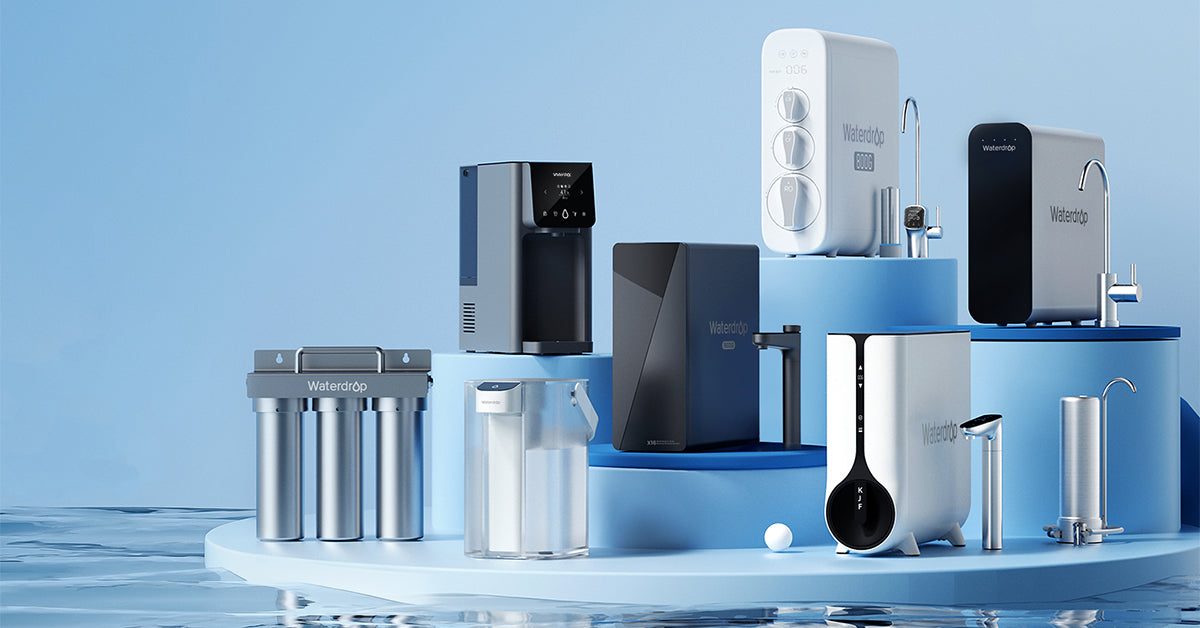
Waterdrop offers one of the broadest filtration ranges online, and its tankless under-sink reverse osmosis systems are the standouts, with multiple NSF/ANSI certifications, smart faucets and efficient drain ratios. The sheer size of the catalog can be confusing, so match the system to your water before buying.
What we like
- Tankless RO systems such as the G3P800 carry NSF/ANSI 42, 53, 58 and 372 certifications
- Efficient designs, with the G3P800 rated at a 3:1 pure-to-drain ratio
- Smart faucets that show TDS and filter life, plus tool-free twist-lock filter changes
- Options at nearly every budget, from a $39.99 inline filter to 1,600 GPD systems
- Free shipping and returns advertised on orders
Keep in mind
- The catalog is very large and model names are hard to compare
- Certification coverage varies by product, so check each listing
- Premium tankless systems are expensive at full price
- Under-sink RO needs installation and some cabinet space
Waterdrop has become one of the most visible names in home water filtration, largely thanks to its tankless reverse osmosis systems. By removing the bulky storage tank that traditional RO relies on, these units free up cabinet space and deliver purified water on demand. Around that core, the brand sells countertop RO dispensers, pitchers, faucet filters, fridge filters, whole-house systems and even an espresso machine.
We sorted through the catalog to work out which products matter most, what is certified, what things cost and how to choose. Waterdrop is a good place to shop if you know what you need, and a slightly overwhelming one if you do not.
What Waterdrop sells
The range is organized into several families:
- Under-sink RO: tankless systems rated from roughly 450 to 1,600 gallons per day, including alkaline versions with remineralization and models with instant hot water.
- Countertop RO: plug-in dispensers that need no plumbing, many with hot and cold water.
- Under-sink filters: simpler carbon and ultrafiltration systems that do not use RO.
- Countertop and pitchers: pitchers, an electric pitcher, gravity filters and faucet filters.
- Whole house: sediment, multi-stage and iron and manganese filters, spin-down filters and softeners.
- Fridge filters and outdoor: replacement fridge filters for brands such as LG and GE, plus RV, garden and car wash filters.
The flagship: tankless under-sink reverse osmosis
The G3P800 is the model most reviews focus on. It is an 800 GPD tankless system that Peak and Pick describes as filling a cup in about five seconds, with a UV sterilizing light, a smart faucet that displays TDS and filter life, and twist-and-lock filters you change without tools. It carries NSF/ANSI 42, 53, 58 and 372 certifications, covering aesthetic contaminants, health-related contaminants, RO system performance and lead-free materials. Waterdrop rates it at a 3:1 pure-to-drain ratio, which is far more efficient than older tank systems.
Above it sit the X12 (1,200 GPD) and X16 (1,600 GPD), aimed at large households and heavy cooking. Below it, the G3P600 offers 600 GPD for less, and alkaline models such as the G5P700A and T4-A add a remineralization stage for people who find RO water flat.
See Waterdrop's current range
Tank versus tankless: why it matters
Traditional reverse osmosis is slow, so it fills a pressurized storage tank in the background and serves you from that reserve. It works, but the tank takes up much of the cabinet, water can sit for hours, and pressure drops as the tank empties. Older systems also sent several gallons down the drain for every gallon of purified water.
Tankless designs use more powerful pumps and membranes to purify water as you pour. The practical benefits are a smaller footprint, more consistent flow and less water sitting in storage. The trade-offs are that tankless units need an electrical outlet under the sink, and the most powerful models cost more than basic tank kits. Waterdrop's lineup spans enough output levels that most households can find one sized for their needs without paying for capacity they will never use. If you already have an outlet under the sink, tankless is usually the more convenient choice.
Pricing across the range
Listed prices during our research, which included holiday promotions, were:
- X16 Undersink RO: $1,599
- X12 Undersink RO: $1,099
- G3P800 Undersink RO: $849
- X8-A Alkaline RO: $699
- G3P600 Undersink RO: $439
- G5P700A Alkaline RO: $309.99
- T4-A Alkaline RO: $259.99
- Countertop RO dispensers: about $219 to $499
- Whole-house filters: about $119.99 to $269.99
- Faucet filter: $69.99; electric pitcher: $44.99; inline under-sink filter: $39.99
Waterdrop frequently runs sitewide and model-specific promotions, including a discount for email signup, so full price is rarely the price you need to pay.
How to choose the right Waterdrop
- Can you install under the sink? If not, look at the countertop RO dispensers or a pitcher.
- How much water do you use? A couple or small family is well served by 600 to 800 GPD. Larger households that cook a lot may appreciate the X12 or X16.
- Do you want minerals back? Choose an alkaline or mineral RO model.
- Is reverse osmosis necessary? If your water is generally good and you just want better taste, a certified carbon under-sink filter costs a fraction of RO.
- Check certifications per model. Some simpler filters are certified only to NSF/ANSI 42 and 372, which cover taste, odor and lead-free materials but not health-related contaminant reduction.
Shipping, returns and ownership
Waterdrop's site advertises free shipping and returns on orders, with full terms in its shipping and return policies. Replacement filters for the RO systems come in separate CF, CB and RO cartridges, and combo kits bundle a year or more of filters, which is the most economical way to buy. Lifespans vary by stage and water quality, and the smart faucets on many models tell you when a change is due.
Who it suits, and our verdict
Great for: homeowners who want space-saving tankless RO, renters who want a plug-in countertop RO dispenser, and value hunters looking for a specific filter type at a fair price.
Less ideal for: shoppers who want a small, curated range and simple choices, or anyone who needs whole-home treatment for a complex well, where a specialist may be better.
Our verdict: Waterdrop's tankless reverse osmosis systems are among the most compelling in their price bands, with strong certifications, efficient drain ratios and genuinely useful smart faucets. Take time with the catalog, confirm certifications on the exact model you choose, and you are likely to get very good value.
Waterdrop products at a glance
| Product | What it is | Price |
|---|---|---|
| G3P800 Tankless RO | 800 GPD under-sink reverse osmosis with UV and a smart TDS faucet. | $849 |
| X12 Undersink RO | 1,200 GPD tankless system for large households. | $1,099 |
| G3P600 Undersink RO | 600 GPD tankless RO for smaller households and budgets. | $439 |
| T4-A Alkaline RO | 450 GPD reverse osmosis with a remineralization stage. | $259.99 |
| C1S CoreRO | Countertop reverse osmosis that needs no plumbing. | $219 |
| WHF21-PG Whole House | Two-stage whole-house pre-filtration system. | $119.99 |
Prices as listed on the brand's site at the time of our research and may change. Check the store for current pricing.
Waterdrop FAQs
Is Waterdrop legit?
Yes. Waterdrop is a large filtration brand selling online, with many models certified to NSF/ANSI standards. Certifications vary by product, so check each listing.
What does tankless reverse osmosis mean?
Tankless RO filters water on demand instead of storing it in a pressurized tank, which saves cabinet space and helps deliver fresher water.
Which Waterdrop RO system is best?
The G3P800 is the most widely recommended all-rounder, with NSF/ANSI 42, 53, 58 and 372 certifications. Larger homes may prefer the X12 or X16.
Does Waterdrop RO remove fluoride and PFAS?
Waterdrop says the G3P800 reduces fluoride, PFAS, heavy metals and VOCs. Check the model's performance data sheet for exact figures.
Does Waterdrop offer free shipping?
Waterdrop's site advertises free shipping and returns on orders. See its policies for full terms.
Buyers who want tankless reverse osmosis or a specific filter type at a competitive price
Disclosure: InhouseHeal may earn a commission if you buy through links on this page. Our score is based on research of the brand's products, evidence, pricing and policies. How we review.