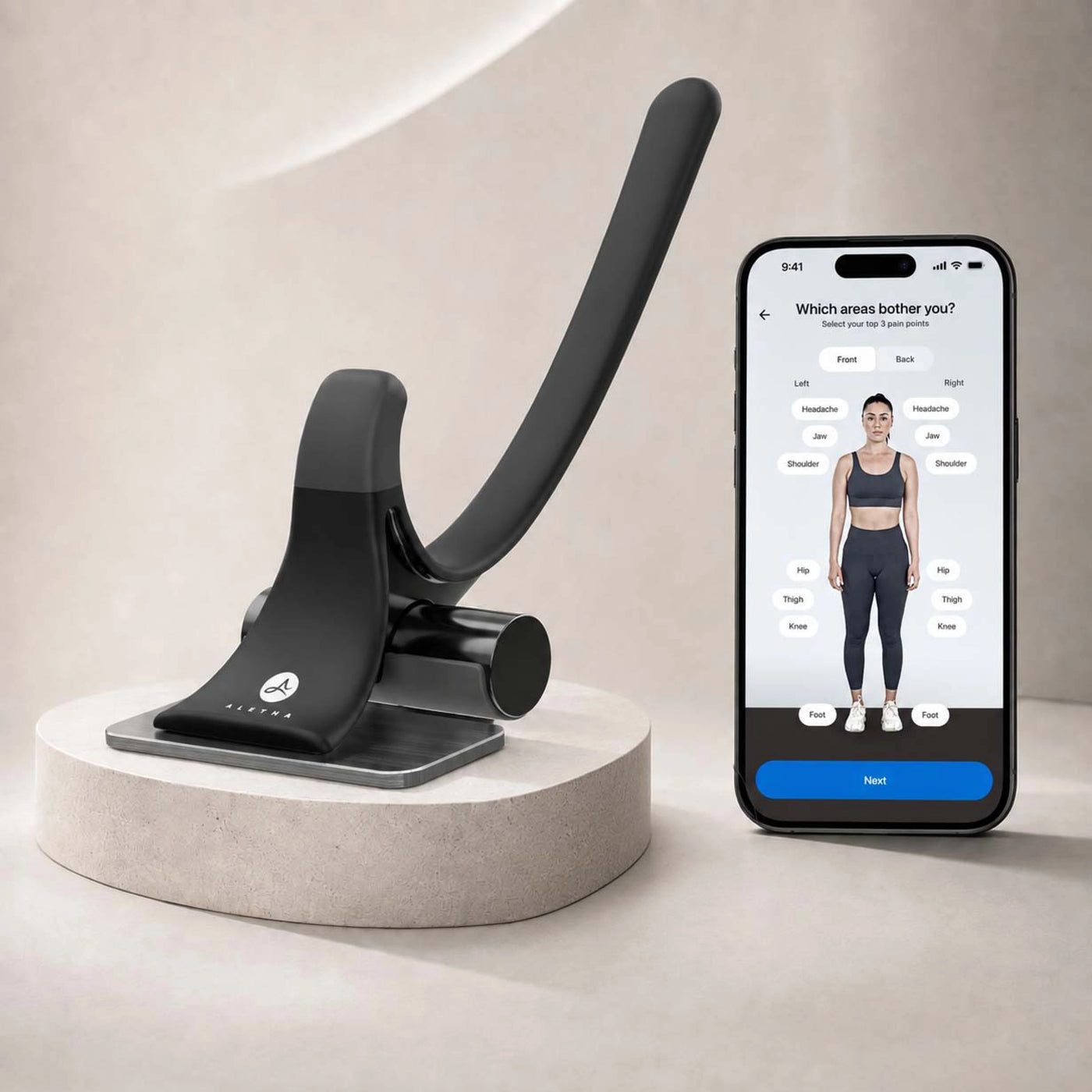
Aletha Health makes a small, focused set of muscle-release tools designed by physical therapist Christine Koth, led by the Hip Hook for the hard-to-reach iliacus and psoas. They are well thought out, made in the USA and come with good educational support, but the hero tool is expensive for what it is and needs careful technique.
What we like
- Designed by a licensed physical therapist and author of a book on hip tension
- Hip Hook targets the iliacus and psoas, which foam rollers and balls rarely reach
- Made in the USA by a women-owned small business
- HSA/FSA eligible, with 60-day returns advertised
- Plenty of how-to videos and written guidance
Keep in mind
- The Hip Hook costs far more than a lacrosse ball or foam roller
- Deep abdominal and hip flexor pressure is not suitable for everyone
- Third-party listings describe different return terms, so confirm the policy at checkout
- Narrow range: mostly hips, glutes and neck
Long days in a chair do quiet damage to the hips. The deep hip flexors, the iliacus and psoas, sit tucked behind the abdomen where foam rollers and massage guns cannot reach, and when they tighten they can tug on the pelvis and lower back. Aletha Health was created to tackle exactly that area.
The company was founded by physical therapist Christine Koth, author of Tight Hip, Twisted Core, and its tools grew out of techniques she used in clinic. We looked at each product, what it targets, what it costs, and who is likely to get the most out of it.
The idea behind Aletha
Aletha's argument is simple: some of the muscles most affected by sitting are very hard to release on your own. The iliacus lines the inside of the pelvis, and the psoas runs from the lower spine to the thigh. Hands-on release by a therapist can help, but appointments are expensive and infrequent. Aletha's tools are shaped to let you apply sustained, targeted pressure to these areas at home, plus a few other common trouble spots such as the glutes and the base of the skull.
The brand describes its products as made in the USA and identifies as a women-owned small business. Rather than a sprawling catalog, it keeps to a handful of tools and supports them with videos, articles, a book and an online course.
Each tool, and what it is for
- Hip Hook (also called Mark): the flagship. A hooked tool you use lying face down, positioning the tip just inside the front of the pelvis to apply steady pressure to the iliacus and psoas. It is the product most people come to Aletha for.
- Range (formerly the Nuckle): a small, portable tool for the suboccipital muscles at the base of the skull, the upper neck and the jaw area. Useful for people who carry tension from screen work or clench their teeth.
- Orbit: a firm, ergonomically shaped release ball for the glutes, piriformis and outer hip. It can be used standing against a wall, seated or lying down.
- Band: a medium-resistance band for strengthening the smaller glute muscles that stabilize the hip, the logical follow-up to releasing tight tissue.
- Full Body System: the Hip Hook, Range, Orbit and Band bundled with the book.
The site also lists a wedge, certified pre-owned tools and a course.
See Aletha Health's current range
What to buy first
If your main complaint is a stiff front of hip, lower-back tightness after sitting or a feeling that one hip is 'stuck', the Hip Hook is the reason to shop here. It was listed from $149, down from $199, when we checked. Pair it with the inexpensive Band so you strengthen as well as release.
If you are not sure where your tension comes from, the Full Body System, listed from $221 against a $371 list price, is better value than buying the pieces separately and gives you a tool for each area. On a tight budget, start with the Orbit at $29 for glute and piriformis work; it covers ground similar to a massage ball but with a shape that is easier to position.
Using the Hip Hook safely
Go slowly. Start with light pressure for short periods, follow the brand's placement videos closely and stop if you feel sharp pain, a pulse under the tool, or numbness or tingling. This is a tool to use with patience, not force.
Pricing, shipping and returns
When we checked, prices ran from $19 for the Band and $29 for the Orbit, through about $99 for the Range and $149 for the Hip Hook, up to $221 for the Full Body System. The book started at around $10. Products are listed as HSA/FSA eligible, which helps US buyers using pre-tax funds.
Aletha ships within the US and internationally. Third-party reviews cite free shipping in the continental US on orders over $75 and typical domestic delivery of three to seven business days. The brand's homepage advertises 60-day returns, though some outside listings describe stricter terms for opened items, so read the current policy before you open the box if you think you may return it.
Who Aletha suits, and who should be cautious
Aletha's tools are a good match for desk workers, drivers, students and gamers who sit for long periods, as well as runners, cyclists and lifters with chronically tight hip flexors. The Range is a neat option for people who get tension headaches or jaw tightness linked to posture, though anyone with migraines or TMJ disorder should get a professional diagnosis first.
People who should check with a doctor or physical therapist before using the Hip Hook include anyone who is pregnant, has had recent abdominal or hip surgery, or has a hernia, a known vascular problem in the abdomen or unexplained abdominal pain. Pressing into the front of the pelvis is not appropriate in those situations.
How Aletha compares with cheaper options
A lacrosse ball, foam roller or generic massage ball will handle glutes and hamstrings perfectly well for a few dollars. Where Aletha earns its premium is the Hip Hook's reach into the iliacus and psoas, an area those tools simply cannot target, and the clinical thinking behind each design. If your problem is in that deep front-of-hip area, it is a worthwhile buy. If it is general muscle soreness, simpler tools may do.
Our verdict
Aletha Health is a credible, clinician-led brand with one genuinely distinctive product. The Hip Hook is expensive and needs careful technique, but for stubborn hip flexor tightness it offers something few other tools can, and the educational material helps you use it well. Start with the Hip Hook and Band, or the Full Body System if you want everything.
Aletha Health products at a glance
| Product | What it is | Price |
|---|---|---|
| Hip Hook (Mark) | Hooked release tool for the iliacus and psoas deep hip flexors, used lying face down. | from $149 |
| Range | Compact tool for the base of the skull, upper neck and jaw muscles. | from $99 |
| Orbit | Firm shaped release ball for glutes, piriformis and outer hip. | $29 |
| Band | Medium-resistance band for strengthening the hip-stabilizing glute muscles. | $19 |
| Full Body System | Hip Hook, Orbit, Range and Band plus the book Tight Hip, Twisted Core. | from $221 |
Prices as listed on the brand's site at the time of our research and may change. Check the store for current pricing.
Aletha Health FAQs
Is Aletha Health legit?
Yes. Aletha Health was founded by physical therapist Christine Koth, sells tools it describes as made in the USA, and lists HSA/FSA eligibility and a 60-day return policy.
What does the Aletha Hip Hook do?
It is designed to let you apply sustained pressure to the iliacus and psoas, deep hip flexor muscles that are hard to reach with rollers or balls. Many people use it to ease front-of-hip and lower-back tightness from sitting.
Is the Hip Hook safe to use?
Used gently and as instructed, many people find it helpful. Avoid it if you are pregnant, have had recent abdominal surgery, have a hernia or abdominal vascular condition, and stop if you feel a pulse, sharp pain or tingling.
Which Aletha product should I buy first?
Start with the Hip Hook if your tightness is in the front of the hip or lower back, or the Full Body System if you want tools for the hips, glutes and neck. The Orbit is the budget entry point.
Can I use HSA or FSA funds at Aletha Health?
Aletha lists its products as HSA/FSA eligible. Check with your plan administrator about any paperwork required.
Desk workers and active people with tight hip flexors, low-back tension or upper-neck tightness
Disclosure: InhouseHeal may earn a commission if you buy through links on this page. Our score is based on research of the brand's products, evidence, pricing and policies. How we review.