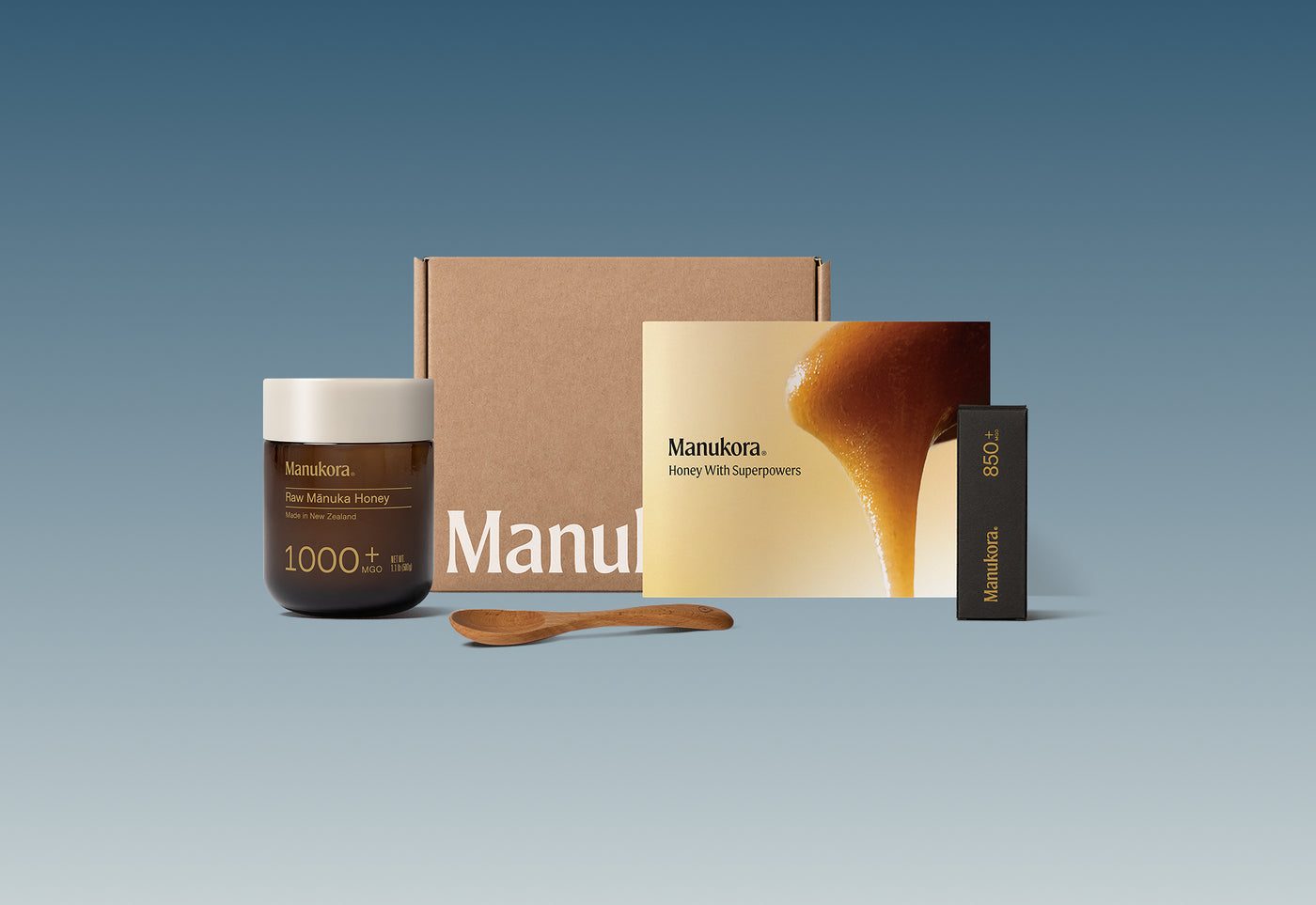
Manukora is one of the most transparent manuka honey brands, with clear MGO grading, third-party testing, glyphosate-residue-free certification and full traceability to source. It is expensive, as all genuine high-MGO manuka is, but the labeling makes it easy to know exactly what you are paying for.
What we like
- Clear MGO grades from 600+ to 1000+, labeled on every jar
- Third-party tested for purity and potency, and 100% traceable
- Certified glyphosate residue-free and monofloral
- Raw honey in amber glass jars
- Starter kits and Bioactive Blends with strong customer ratings
Keep in mind
- High-MGO honey is expensive per jar
- Honey is still sugar, so portion size matters
- Health benefits of manuka are mostly studied for topical use, not daily eating
- Not suitable for infants under 12 months
Manuka honey comes from bees that forage on the flowers of the manuka bush, native to New Zealand. It is prized for a compound called methylglyoxal, or MGO, which gives manuka its distinctive properties and is the reason high-grade jars cost so much more than ordinary honey. Unfortunately, the premium price has also made manuka one of the most commonly mislabeled foods in the world.
Manukora's pitch is transparency: honey harvested by independent beekeepers across remote parts of New Zealand, independently tested, clearly labeled by MGO and traceable to its source. We looked at the grades, the products, the testing claims and how to decide which jar to buy.
MGO grades, explained
MGO is measured in milligrams per kilogram, so MGO 850+ means at least 850 mg of methylglyoxal per kilogram of honey. The higher the number, the more potent and the more expensive the honey. Manukora sells three main grades:
- MGO 600+: a strong daily grade and the entry point for regular use, sold as part of a starter kit.
- MGO 850+: the brand's most popular grade, balancing potency and price.
- MGO 1000+: the premium grade, with a rich texture and deep flavor, for people who want the highest regular potency.
Manukora has also listed an MGO 1200 product. As a rough guide, higher grades are chosen by people who take manuka specifically for wellness reasons, while lower grades are perfectly good for enjoying in tea or on toast.
Sourcing and testing
Manukora's honey is produced entirely in New Zealand, harvested by independent beekeepers working in remote areas where manuka grows naturally, away from industrial agriculture. One of its founding master beekeepers works in the far north of the country, and the brand describes an ethical beekeeping standard across its supply.
On quality, Manukora says its honey is:
- Third-party tested for purity and potency
- Monofloral, meaning predominantly from manuka flowers
- Certified glyphosate residue-free
- 100% traceable to its source
- Raw and packed in amber glass to protect it from light
The brand also says it oversees the full supply chain, from hive placement and harvesting to testing and packaging. That level of control is exactly what you want in a category where adulteration and inflated grades are real problems.
See Manukora's current range
Products and prices
Raw manuka jars
Jars are 250 g (8.82 oz). MGO 850+ starts at about $64 and MGO 1000+ at about $96.
Starter kits
Kits bundle honey with accessories and are themed around common goals. The MGO 600+ kit is about $85, the MGO 850+ kit about $64 and the MGO 1000+ kit about $96, and the brand regularly runs discounts on starter kits.
Bioactive Blends
A newer range of botanical extracts suspended in manuka honey, sold in canisters and stick packs at about $99 each: Immunity + Defense (made with MGO 850+), Body Recovery + Gut, and Energy + Clarity.
Customer ratings are very high across the range, with the MGO 850+ jar alone showing thousands of reviews averaging close to five stars.
How to choose and use your manuka
If you are new to manuka, MGO 850+ is the sensible starting point: it is the brand's best-selling grade and a meaningful step up from supermarket manuka without the price of 1000+. Choose 600+ if you mainly want to enjoy the flavor every day, and 1000+ if you are committed to manuka as a regular ritual and want maximum potency.
Most people take a teaspoon a day, straight from the spoon, stirred into warm (not boiling) tea, or drizzled over yogurt. Very hot liquids can affect some of honey's natural compounds, so let tea cool slightly first. Store the jar at room temperature, tightly sealed; raw honey can crystallize naturally over time, which does not affect quality.
How to spot genuine manuka, from any brand
Because high-grade manuka commands such high prices, the category has a long history of blended, diluted or over-labeled honey. Whether you buy Manukora or another brand, a few checks help:
- Look for an MGO number rather than vague terms like "active" or "premium." A measured MGO figure is the clearest indicator of potency.
- Check that it is produced and packed in New Zealand. Genuine manuka is a New Zealand product, and honey packed elsewhere is harder to verify.
- Ask about testing. Reputable brands use independent labs and can tell you how batches are verified.
- Be wary of very cheap high-MGO jars. If a jar labeled MGO 800+ costs the same as ordinary honey, something is likely off.
- Look for traceability. Batch numbers that link back to a source are a strong sign of a well-run supply chain.
Manukora ticks each of these boxes, which is the main reason it rates well in our research.
What the evidence says
Manuka honey has been studied most for topical use, such as medical-grade honey in wound dressings, where its antibacterial properties are well documented. Evidence for benefits from eating manuka, for example on digestion or immunity, is more limited and mixed. Honey is also a traditional and reasonable home remedy for soothing a sore throat or cough in adults and children over one year old.
That means manuka is best enjoyed as a high-quality food with interesting properties rather than a treatment. Manukora's own disclaimer notes that its statements have not been evaluated by the FDA and its products are not intended to diagnose, treat, cure or prevent disease.
Our verdict
Manukora is a trustworthy choice in a category where trust is hard to come by. Its MGO labeling, testing, traceability and glyphosate certification set a high standard, and the honey itself is consistently well reviewed. The price is steep, but that is true of all genuine high-grade manuka. Start with a jar of MGO 850+ and decide whether a higher grade is worth it for you. Gift buyers will also find the kits well presented.
Manukora products at a glance
| Product | What it is | Price |
|---|---|---|
| MGO 850+ Raw Manuka Honey | The brand's most popular grade in a 250 g amber glass jar. | from $64 |
| MGO 1000+ Raw Manuka Honey | The premium high-potency grade with a rich, deep flavor. | from $96 |
| MGO 600+ Starter Kit | An entry-level daily grade bundled with accessories. | about $85 |
| Bioactive Blends: Immunity + Defense | Botanical extracts in MGO 850+ manuka, in canister and stick-pack formats. | about $99 |
| Bioactive Blends: Body Recovery + Gut | A manuka-based blend focused on recovery and digestion. | about $99 |
Prices as listed on the brand's site at the time of our research and may change. Check the store for current pricing.
Manukora FAQs
What does MGO mean on manuka honey?
MGO stands for methylglyoxal, the compound most associated with manuka's properties. The number shows the minimum milligrams of MGO per kilogram of honey.
Which Manukora grade should I buy?
MGO 850+ is the best starting point for most people. Choose 600+ for everyday enjoyment at a lower price and 1000+ if you want the highest regular potency.
Is Manukora honey raw?
Yes. Manukora sells raw, monofloral manuka honey packed in amber glass jars.
Is Manukora tested?
Manukora says its honey is third-party tested for purity and potency, certified glyphosate residue-free and 100% traceable to source.
Can children eat manuka honey?
Honey of any kind should never be given to babies under 12 months because of the risk of infant botulism. For older children, small amounts are generally fine.
Manuka honey buyers who want clear MGO labeling, traceability and third-party testing
Disclosure: InhouseHeal may earn a commission if you buy through links on this page. Our score is based on research of the brand's products, evidence, pricing and policies. How we review.